For people who know they're capable of more
The thing that's been keeping you stuck has a name.
You decided. You worked. It still won't move. That's not a work ethic problem. There's a story standing between you and what's actually happening, and you can't see it because you're standing inside it. Breaking the Mirage teaches you how to stop long enough to see it.
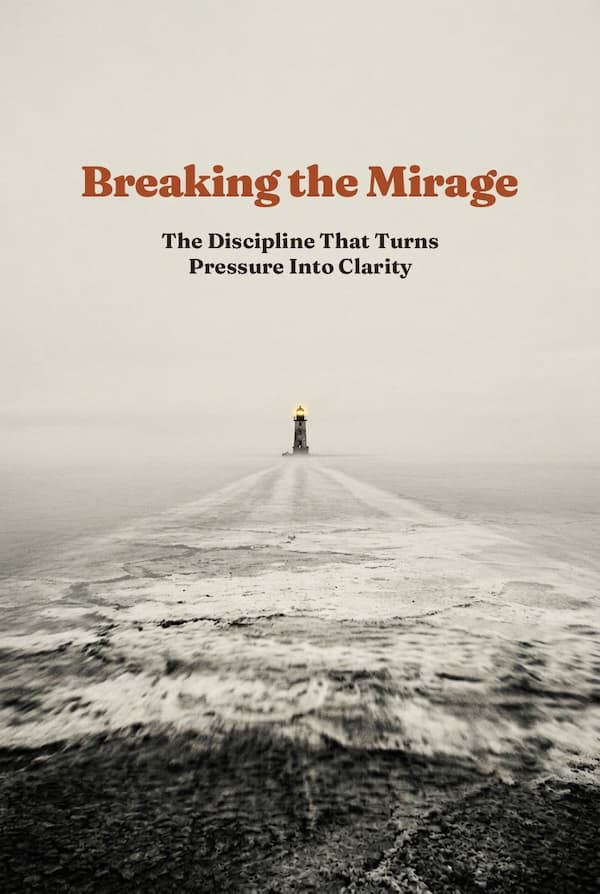
A 45-minute read. Instant download. If it doesn't change how you see your next decision, reply to your receipt and I'll send the $27 back.
You've done everything right. That's what makes it so confusing.
You've read the books. Work on the business, not in it. Find your why. Fail forward. You can quote them all, and you outwork everyone in your circle.
And you're still stuck. So the problem was never that you didn't know enough or didn't work hard enough.
Here's what's actually happening. Somewhere along the way, a story got between you and the facts. The client is just slow to pay. Good people are impossible to find right now. It isn't the right time. Each one is the version you can live with, and you've been steering by the version instead of the facts.
That gap between the story and the facts is the mirage. And the cruel thing about a mirage is that it looks most like water exactly when you're most desperate for it.
You can't fix what you can't see. This teaches you to see it.
Most business books hand you a new strategy. This one shows you why the last three strategies didn't take.
Breaking the Mirage is the first move of the Contra Kai decision framework: the discipline of stopping long enough to separate the story in your head from the situation in front of you.
Not my story handed to you so you can nod along. Yours, seen clearly, for the first time. Because only you can shift it, and you can't shift what you can't see.
This is the first step of the framework, not the whole thing. It's the step everything else depends on, and it's the one you can start running the same day you read it.
45-minute read · Instant download
Stop steering by the story. Tonight.
If you're burning 10–15 hours a week circling decisions you've already made, the book isn't the cost. The circling is.
Inside the book
- The four-second interrupt that decides whether your next move costs you or pays you. I learned it live, with thirty million dollars on the line and a fake billion on the leaderboard.
- The two kinds of pressure that put you in motion, and how to tell the real one from the movie running in your head while you sign checks.
- Why the hardest workers stay the most stuck: the mask of productivity, and the busy that never lands.
- Meaning and model, the two forces everything you build runs on, and the three questions that show you which one you're starving right now.
- The mirage itself: how a story I carried for seven years shattered in one sentence on a job site, and how to spot the stories steering your business.
- The comfort loop that keeps your stories safe: hedging, outsourcing, disappointment, chasing comfort, and why you can't see the pattern from inside it.
- Two mountains: why the success you already earned is giving you the wrong map for the climb you're on now.
- The verdict: how your results quietly became the measure of you, and what that's costing every decision you make.
Every one of these was paid for in real weather, with real money on the line. A half-million-dollar loan. A company that went from thirteen people to four. A kitchen conversation with my wife I'll let the book tell you about.
Less than lunch. It'll outlast every strategy you've bought so far.
Free doesn't get read. Twenty-seven dollars is an easy yes with just enough skin to make you actually open it — and if it doesn't land, it's free anyway.
Read it tonight. Run it tomorrow.
This is a 45-minute read on purpose. It's not a 300-page brick you'll nod at and shelve. It's short enough to finish in one sitting and built to change how you see the very next decision in front of you.
It's for you if
- You know you're capable of more than your results are showing
- You keep deciding and the decisions keep not getting done
- You're tired in a way sleep won't touch, and working harder stopped working a while ago
It's not for you if
- You want a tactic dump and have no interest in looking at what's actually steering you
- You want the entire framework in one sitting. This is step one, and I'm honest about that.
What people say after a conversation with the guy who wrote it.
Dave has a rare ability to take complex issues — whether in business or family life — break them down, and come up with executable plans that actually work. The conversations about navigating entrepreneurship while being a husband and a father — that's priceless. It's something every entrepreneur needs, especially if you have a family.
Dave has one philosophy that becomes invaluable the moment you understand it. You are not just your work. You are not just your business. You have to dig deep to find out who you really are, what you value, and the kind of life you actually want to live. If you want to keep living the same stressed, unfulfilling life as everyone else, Dave is not for you. But if you want to live with authenticity, joy, and real purpose, Dave is your man.
Dave is the kind of man who pushes you to look inward and take real ownership. No shortcuts, no excuses. Our conversations have been grounded, direct, and very meaningful. He's good at bringing clarity, accountability, and a standard that'll call you up, not call you out.
Why twenty-seven dollars
Because free doesn't get read. Free gets downloaded, skimmed, and buried in a folder with forty other PDFs. Twenty-seven dollars is small enough to be an easy yes and just enough skin to make you actually open it.
And run it against the other side of the ledger. If you're burning ten to fifteen hours a week circling decisions you've already made, put your rate on that and do the math on one month.
The book isn't the cost. The circling is.
The book isn't the cost.
The circling is.
Read it. If it doesn't change how you see your next decision, reply to your receipt and I'll send the $27 back. No form, no hoops.
The risk here is mine.
There's no timer on this page.
No countdown, no fake scarcity, no price that jumps at midnight. It's a book. It'll be here tomorrow.
But the only clock that matters has been running for a while: every week the thing stays stuck is a week you don't get back. You know that better than I do. That's why you're on this page.

Who wrote this
I ran a systems integration company for over a decade. Seven figures, celebrity campaigns, thirty-million-dollar launches. I built the technical backbone of Team Seas for MrBeast and Mark Rober, and I nearly torched it in four hours because of what pressure did to my judgment.
Then I signed a half-million-dollar loan every indicator said was safe, watched the company come apart underneath me while my family went through the hardest eighteen months of our lives, and shut it down.
The framework in this book is what I built on the other side of that. It's not theory. Every piece of it has a receipt.
The honest answers.
What exactly do I get for $27?
The full book, instant download, about a 45-minute read. The first step of the Contra Kai decision framework, taught through the real events that built it.
Is this just another mindset book?
No. Mindset books tell you to think positive. This one shows you the specific mechanism that's been steering your decisions and teaches you to catch it running. There's a four-second practice in chapter one you can use the same day.
I don't have time to read.
It's 45 minutes, and if being too busy is the reason you can't spend 45 minutes on the thing underneath every hour of your week, that's not a scheduling problem. That one's in the book too.
Is this the whole Contra Kai framework?
No, and I won't pretend it is. It's the first step: seeing the story you're deciding through. It's the step everything else depends on, and it stands on its own. What comes after it is a different conversation, and the book will tell you where that conversation happens.
What if it doesn't work for me?
Then it's free. Reply to your receipt, the $27 comes back, and you keep the book. I only keep the money if it moved something.
Read it tonight.
Run it tomorrow.
P.S. You've out-worked this problem for years and it's still here. That's your proof it was never a work problem. You won't out-work this one. You'll out-see it. That's what the book teaches.
Breaking the Mirage is a book of ideas and personal experience. It is not medical, psychological, legal, or financial advice, and it makes no promise of income, results, or specific outcomes. If you're in genuine crisis, please reach out to a qualified professional — a book is no substitute for one. This page is not affiliated with or endorsed by any platform an ad for it may appear on.