The decisions that cost you don't feel hard. They feel obvious.
You feel the pressure, make the decision, and end up stuck in the gap between where you wanted to go and where you ended up. And you keep ending up there.
The decisions that always worked start failing.
You've made good decisions for years. But what worked at one stage strains at the next.
More people, more money, more riding on every decision.
The weight compounds faster than you adapt, and things start to slip:
- A project you bet on falls apart.
- A client you were sure of walks.
- Revenue you counted on drops out from under you.
So you reach for what's always worked:
- Work harder.
- Take it all on yourself.
- Tell yourself you're handling it.
Then it's 2am, the world's finally quiet, and the thing you've been outrunning settles onto your chest.
Maybe I've lost the instinct that built this.
I built a tech company from $500 to seven figures. Twelve years advising founders. I've helped companies scale past eight figures.
I've made the hire that saved a year and the one that cost one. I know how these calls feel, because I've made them with real money on the line.
I've sat in the decision with a live audience watching and 30 million dollars riding on the next thirty seconds.
The company I built was never really a tech company. It was a solutions company that happened to build the tech.
I built the wrong damn thing, and it took me years to see it. A seven-figure company can still be the wrong company. One decision at a time, I drifted into a business I never set out to build.
The real value was helping people get clear on what they were actually building, so they could make the decisions that got them there.
So that's the work I do now. I get in the room with founders and run their real decisions through the framework I built to get myself out, until they can see it straight.
When you own the choice, the outcome never owns you.
In August 2021, I sat in on a pitch call for Team Seas, MrBeast and Mark Rober's campaign to raise thirty million dollars.
Launch was 73 days out, and everyone on the call wanted to talk about design and conversion optimization.
Two questions
Q: What's the lowest donation you'll accept?
A: One dollar.
Q: Who's your merchant?
Silence. Nobody in the room knew they needed one.
So I laid it out right there:
- open one-dollar transactions to millions of people, fraud shows up on day one
- stolen cards tested against your checkout
- merchant will shut you down without a relationship
- funds frozen mid-campaign
Then I gave them the plan on that call:
- Get Stripe on board (MrBeast tweeted their CEO)
- Build for the fraud before it comes
- Freshdesk for the tickets
- Shopify for the merch
- AWS for the infrastructure
- Cloudflare to stay standing under attack
An answer for every gap, on one call.
We won the contract two days later.
Launch day, the site took $260,000 in the first seven minutes. The fraud hit on day two, forty attempts per second. We were ready. The site never went down, and the campaign raised thirty million by January first.
They came in concerned about uptime.
But what was missing wasn't technical.
- No merchant
- No customer service
- No disaster response plan
That's an operation flying blind.
Without my plan, this campaign never happens. Or it launches and folds on day two.
That's the work.
“Dave was instrumental in the success of the #TeamSeas campaign. Together, we not only achieved our goal of crowdfunding $30M to fund beach and river cleanups, but also raised the bar for social impact in the creator economy. His diagnostic questions helped us anticipate and prevent potential challenges in custom-building a global donation platform, ensuring a successful launch and adaptive response to emergent threats. Having Dave as a sounding board was invaluable and he was one of my first calls when I began planning the sequel.”
Matt Fitzgerald, Co-Founder, #TeamSeasFounder & Principal, fitz.partners
A founder came to me ready to scale. Years of proof behind her training business, and a plan to take it to enterprise companies.
Every consultant she asked told her the same thing:
Build it on cheap software. Prove it works first.
She'd already done that. Rebuilding it on another cheap platform meant spending months of time and money to land at the same ceiling.
They were handing her advice for a stage she'd already finished.
So we worked the decision from her real stage: investment.
The plan shifted from building to blueprinting the minimum viable experience that sells this to her target audience. Every user, every screen, every story, before hiring a single person to build it.
That's the difference between a quarter-million-dollar cost and a lean investment in a sellable product that brings in revenue as it grows into its market.
She told me she hadn't heard any of it from anyone else.
The same read shows up everywhere.
Automation at the wrong time, on the wrong process, increases cost and effort.
Automation at the right time, on the right process, cut one client's manual launch work by 70 percent.
The move is rarely the hard part. Knowing which move, and when, is the difference between investment and cost.
- a pitch call
- a hire
- a fire
- a pivot
- a deal going sideways
The room changes. The work doesn't: see the gaps you can't see from the inside, and leave with the plan.
Working harder isn't the answer. It's the symptom.
Grinding harder doesn't spend your stress, it manufactures more of it.
You're blurring two forces that are not the same but have to be built together.
Meaning is the thing itself. The product, the idea, the reason you're driven to build it at all.
Model is what makes it actually work. Who it's for, the value it delivers, why anyone would pay for it over the alternative. The structure underneath the thing.
Every decision you make holds both, and neither gets to run over the other.
Go all meaning, and you've got something you love that no one buys.
Go all model, and you're perfectly positioned to sell something with no reason to exist.
Meaning without model burns out. Model without meaning hollows out.
Every stuck decision a founder has ever brought me was one of these two out of balance. In our first conversation, you'll see which one is running yours, because you can't rebalance what you can't see.
You're holding on too tight to see it.
Burnout has a mechanism, and it's called grip.
When meaning and model fall out of balance, the outcome starts to matter too much.
You work longer. You push past the limit.
You grind at the deal, the launch, the number, telling yourself more effort will force it through.
Here's the part nobody tells you:
The tighter you grip, the further from done you get.
You start deciding to protect the outcome instead of delivering it, and the goal keeps sliding further away. So you bury yourself under more tasks that feel productive and never move anything.
It feels like drive. It's the opposite.
And you can't tell from the inside. Whatever zone you're in just feels like how life is.
Grip has zones:
- Flowing is the loosest, where you move without forcing and your decisions hold.
- Can't let go is where the work follows you into dinner and into bed, and your judgment goes first.
- White-knuckle is the tightest, where everything feels urgent and you're forcing all of it at once.
Every decision you've made this quarter came out of one of these zones. If you can't name yours, it's been making your calls for you.
Find out which zone you're deciding from.
You can't see your own read while you're in it. Find out which zone you're making your decisions from, and what it's costing you.
The reason it won't move isn't the reason you think.
Every decision carries two pressures:
Outer pressure is tangible. The bill, the deadline, the payroll date. It's there whether you feel it or not.
Inner pressure is the one you build yourself, out of what finishing would say about you. It feels just as real, and it's usually the one steering.
Shallow read, shallow fix. Decide before understanding the problem, the fix never holds.
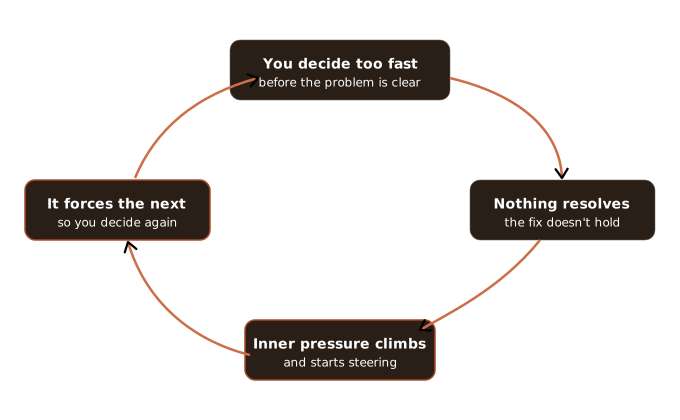
and the process repeats
Four moves break the loop.
On the call, we run your live decision through all four, and you leave with it moving.
See it straight
What's eating you is the story, not the situation. Strip it away and the problem is smaller than it felt at 2am.
Name what matters
Most of it doesn't matter. A few things decide this. The skill is knowing which.
Define the win
If you can't say what good looks like, you won't know if you're getting closer or just getting tired.
Own the choice
The risk doesn't go away. You just stop letting it decide for you.
What changes when you can see.
The four moves aren't the reward. This is:
The stuck thing moves. Decisions sitting for months get made, and held. Goodbye, 2am re-litigation.
Expensive mistakes caught before they cost. The wrong turn gets spotted while it's cheap, not when it's your margin.
The business stops running through you. You stop being the single point of failure, no more sprinting to burnout.
The hours you're burning in circles come back. Focus returns to moving the needle, or to the things that matter most.
The revenue follows. Seeing straight turns time and money from cost into investment.
You walk out with something you didn't walk in with. A plan, a move, a read on the thing you couldn't see.
These aren't promises. They're a track record.
And the one your family notices first: you're at the dinner table, and you're actually there.
What they say.
Dave has a rare ability to take complex issues — whether in business or family life — break them down, and come up with executable plans that actually work. The conversations about navigating entrepreneurship while being a husband and a father — that's priceless. It's something every entrepreneur needs, especially if you have a family.
In one session, Dave showed me I was telling people what my business does, but never why they needed me. In my mind I knew better, but over time you get complacent, and you quietly decide you can't do better than what you're already doing. If you're a business owner, or you just have a busy life, one more meeting sounds unnecessary. Here's the thing: being ineffective is the bigger problem. It leads to stress, waste, and time lost with the people you love. Talk to Dave and reclaim your effectiveness.
Dave has one philosophy that becomes invaluable the moment you understand it. You are not just your work. You are not just your business. You have to dig deep to find out who you really are, what you value, and the kind of life you actually want to live. If you want to keep living the same stressed, unfulfilling life as everyone else, Dave is not for you. But if you want to live with authenticity, joy, and real purpose, the kind of life where every day feels like you're riding high, Dave is your man.
Decisions that cost you the life you thought they'd fund.
If you're still in business, you're winning. It just doesn't always feel like winning.
Because when the results stop matching the output, every open decision starts to weigh.
That weight becomes pressure, and the decisions stop coming from the plan and start coming from the moment.
One decision at a time, the business drifts into one you never set out to build.
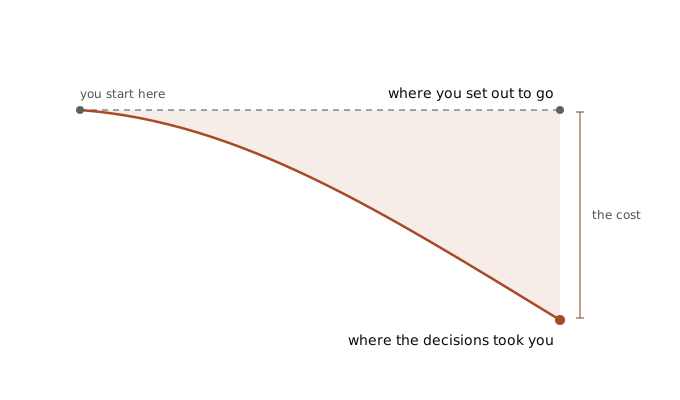
Every month it stays like this, the bill comes due. Most of it, you can count:
- The 10 to 15 hours a week you burn going in circles. Put your rate on that and run the math.
- The decisions you sit on, the hire, the fire, the deal. Sitting on one can cost more than a year of payroll.
- The level you should be at by now. The gap between here and there is the bill nobody itemizes.
- The nights lost to the pressure instead of spent with the people this was all for.
Stop building with your eyes closed.
You already know what to do. You decided months ago. It's still sitting there, half-done, circling, following you into every night.
Bring it.
We work it live, together, and you leave with it moving for real, not another lap around it.
Everything you've been:
- putting off
- handing off
- waiting out
- the conversation
- the hire
- the decision
It's not delegation.
Delegation minus accountability is abdication.
And you've been abdicating the exact things that decide where this goes.
Here's the good news. This isn't a character flaw, and it isn't rare. It's what happens to every builder who's been carrying too much for too long.
And it's very fixable.
Not with more grind, with a system built for exactly this.
You've been trying to get there alone for years. You don't have to anymore.
“Dave is the kind of man who pushes you to look inward and take real ownership. No shortcuts, no excuses. Our conversations have been grounded, direct, and very meaningful. He's good at bringing clarity, accountability, and a standard that'll call you up, not call you out.”
— Rusty Douthat, Retired Master Sgt., USMC · Leadership and Strategic Instructor
Book the call. If it's a fit, you'll know inside the first conversation, and the thing that's been sitting there finally starts to move.